


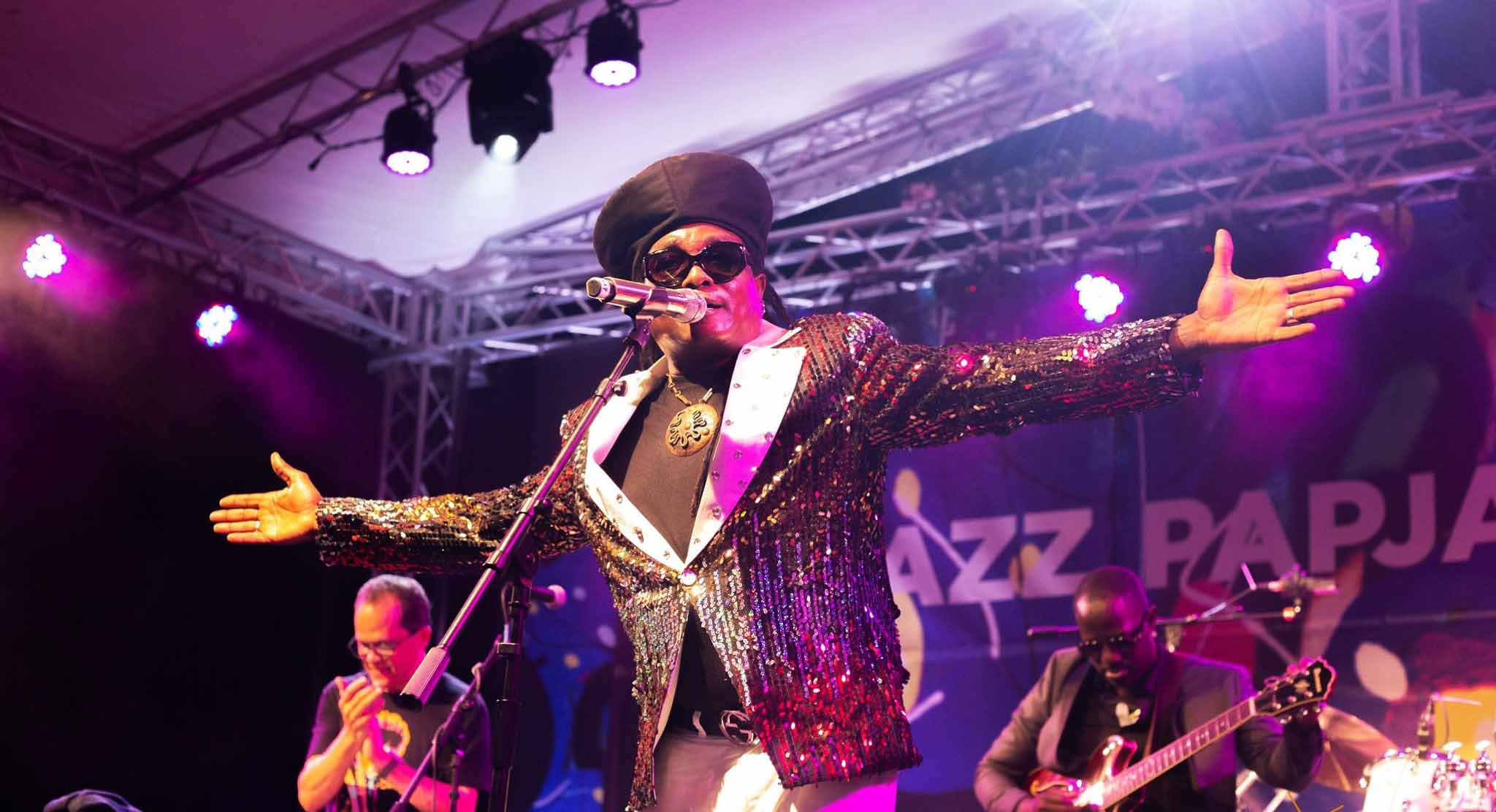
For decades, there has been a musical, spiritual, and cultural communion with Cap-Haïtien-born artist Eddy François, who has established himself as one of the most powerful and symbolic voices in culturally rooted sounds and rhymes. An interesting aspect of his rhythmic journeys with the instrumental component of Haitian spiritual roots through these musical forms, marked by his cultural boldness and creativity, is found in the deepest core of Haitian culture. He has proven to embody critical cultural values, as he accepted his nomination for the acclaimed Grammy Award in Los Angeles, California.
Musical Destiny and the First Note in it for Eddy François
Eddy François, originally from northern Haiti, immersed himself in a rich universe of sounds, blending traditional rhythms with specific cultural and international influences from the 1980s. His first steps into the world we know him as were through a musical choir, where he played guitar and bass. There, he began to convey deep emotions and ideas in his music, which inspired his desire to contribute to the unification of fragmented human souls.
In 1988, he marked a breakthrough in public perception by joining a band called « Konpa Superstar », further solidifying his place among the broad talents of the Haitian cultural and arts scene as a musician primarily promoting roots music.
Boukman Eksperyans: The revelation
The following year brought another breakthrough for Eddy François, when he joined Boukman Eksperyan in 1989. Boukman Eksperyan is one of the most innovative bands of its time, revolutionizing Haitian music by combining traditional voodoo rhythms with rock and pop.
With his unique and voluminous voice that precisely matched the rhythm of roots music, he quickly became the band’s signature and centerpiece. But together they created “Kè m pa sote“, “Pwazon Rat” and “Se Kreyòl nou ye“, many of the musical elements that represent the true essence of Haitian rhythmic sounds. It has later been shown to resonate directly with public voices and promote the cultural and national freedom that Haiti claims.
While his band, Boukman Eksperyans, received a Grammy nomination for their album “Vodou Adjae,” Eddy François was awarded “Best Caribbean Singer” by Rolling Stone Magazine in 1992. Since it was the first time a Haitian band had received such distinguished acclaim in this category, its nomination held historical significance. Raisin music gained international recognition thanks to this pivotal moment.
Boukan Ginen : The Sacred Fire’s Call
Driven by the results of this recognition, Eddy François decided to follow his own artistic vision. In 1994, he founded Boukan Ginen. Launched with “Feu d’Afrique“, which for him was a deeply personal project, where he explored hand in hand the spiritual and cultural roots of Haiti, which he felt clearly intended in his music and his creation.
The first album, “Jou à Rive“, the Boukan Ginen won the RFI Discovery Award.
That year, Boukan Ginen’s performance in Central Park, New York, received widespread attention from major international press platforms. Among these platforms, The New York Times dedicated its entire cover to Boukan Ginen, calling it “Boukan Ginen is a world reference for its devoted fans.”
A Profoundly Spiritual Solo Career
By the early 2000s, Eddy François had resumed a solo career. In 2004, he released Zinga, co-produced with Dadi Beaubru. It later emerged in introspective works as a cultural and musical outlet, leading him to include many albums that celebrated the Haitian people, their cultural hopes, artistic goals, and the culture’s incredible resilience.
In 2008, he deepened his musical adventure with Djohu, but this time recorded in the United States. This album confirmed that the power lies in his message and voice, and he began to form a thick cultural layer of being as a bearer of Haitian consciousness and identity.
A Song of Freedom and Resistance
Throughout his career, as evidenced by his collaborations with Boukman Eksperyans and Boukan Ginen, or in his solo works, Eddy François has established music as an instrument to promote cultural strength and love of cultural identity. His music is deeply rooted in the value of representation and the contribution of our freedom anthem, which has moved away from colonial ideals.
From Tande Kri A Yo to Afrikayiti, and from Lakay to Anacaona, each of his songs promoted the idealism of freedom and Haitian cultural pride, in line with his living archive of resistance and distancing from all ideals of oppression and oblivion.
Living Archive and Legacy
Eddy François tours the world with a message that resonates with Haitian music. From the heart of the voodoo peristyle, where drums echo, lies the story of Haitian freedom and its popular message, documenting cultural values as part of Haitian history. It promotes a more unified acceptance of the idealism of knowing and living our liberty, which is expressed in the component of his music.
Eddy François is an icon of our national identity, an uplifting story, and a still-life symbol of an ever-renewed tradition traveled down from one generation to the next. This legacy can help carry Racine’s music forward while retaining inspiration from it.
© All rights reserved – Media Group MAGHAITI 2025

